

Online continuing education courses for veterinarians solve a problem every small animal practice knows: you want to stay up-to-date professionally, but every day of training is lost to patient care. An evening at your own desk instead of two days with travel, hotel, and finding a substitute fits into many weekly schedules better than a conference weekend.
This article explains how continuing professional development (CPD) requirements are regulated, when online formats qualify for ATF hours, how to recognize quality, and when in-person training with a wet lab remains the better choice. As a concrete example, we present our... Small Animal College 2027 Upcoming: 15 sessions, eight subject areas, live via Zoom or as a recording.
Why online continuing education for veterinarians works in everyday practice
The first advantage is obvious: there's no travel involved. Those working in Kiel, Konstanz, or the Hunsrück region don't need a train or hotel for an evening lecture. This saves costs and, above all, time, and time is often more scarce than the continuing education budget in many practices.
The second advantage concerns the practice itself. For a small team, an in-person seminar on Friday and Saturday often means shortening consultation hours, arranging for coverage, and rescheduling surgeries. In contrast, a live session on Wednesday evening starting at 7 p.m. doesn't require any missed consultation hours, provided the schedule allows for that evening. Good online continuing education courses for veterinarians are therefore designed so that no one has to sacrifice a day of practice to attend.
Thirdly, the learning is better distributed. Instead of a full weekend with eight lectures in a row, there are individual evenings spaced several weeks apart. In between, you work on cases where what you've learned can be directly applied. Someone who has attended an X-ray lecture will look at a chest X-ray differently the next morning.
Of course, the format has its limitations. After a long consultation, concentration levels are low, and those on call can't participate live. Recordings are available for such evenings, but these have implications for the required continuing education hours (ATF hours), more on that later. Therefore, veterinarians choosing online continuing education courses should consider not only the topic but also the time, duration, and day of the week.
Continuing education requirements and ATF hours: What counts online
Before discussing formats and providers, it's worth taking a look at the rules. Whether online continuing education courses for veterinarians count towards their required hours is decided not by the organizer, but by your veterinary association.
What the professional codes of conduct require
Veterinarians are legally obligated to participate in continuing education. This is not regulated uniformly across Germany, but rather in the professional codes of conduct of the 17 state and regional veterinary associations. The German Federal Chamber of Veterinarians (BTK) provides a framework with its model professional code. However, the binding regulations are those adopted by your own chamber, and these may differ from the model.
After the ATF guidelines on non-classroom training courses Section 7, paragraph 2 of the BTK model professional code of conduct for veterinarians stipulates 20 hours of professional development per year. With an additional qualification, this increases to 24 hours, for specialist veterinarians to 30 hours, and for colleagues authorized to provide further training to 40 hours, each with a minimum proportion in their own field.
The chambers implement this differently, including regarding how online continuing education courses for veterinarians are credited. Bavarian State Chamber of Veterinary Surgeons The calculation is based on three-year periods: 60 ATF hours over three years for practicing veterinarians, more for those with additional or specialist veterinary qualifications. The Lower Saxony Chamber of Veterinary Surgeons has its own recognition procedure according to its professional code of conduct, which handles the ATF. Therefore, check your chamber's professional code of conduct before planning your continuing education year.
What the ATF is and what it recognizes
The Academy for Veterinary Continuing Education (ATF) The ATF is the continuing education organization of the German Federal Chamber of Veterinary Surgeons. It offers its own courses and reviews the continuing education programs of other providers. If a program meets its criteria, it receives ATF accreditation with a fixed number of ATF hours. The specific formats and number of hours that your local chamber recognizes are governed by its professional code of conduct.
The ATF calculates the hours based on the pure lecture time, including discussion, excluding breaks and program items such as welcome or introduction. Only whole hours are awarded. The same applies to ATF-accredited online continuing education courses for veterinarians as to in-person courses: Participation is generally limited to veterinarians and veterinary medicine students.
Important for practical purposes: Recognition must be applied for before the start of the training; according to the regulations, retroactive recognition is not possible. ATF Recognition Rules Not possible. As long as the written accreditation is pending, reputable organizers will state "ATF applied for" or "expected ... ATF hours (applied for)." This is not a flaw, but honest communication.
Live online seminar or recording: the crucial difference
The ATF (Academy for Veterinary Continuing Education) distinguishes between two main approaches to online continuing education for veterinarians. The first is the live online seminar without recording, or LOS for short. The presenter and participants are connected at the same time, but not in the same room. After the session, you actively and personally confirm your full participation. Only then is the organizer authorized to issue a certificate of attendance.
The second option is interactive offerings without simultaneous attendance, such as e-learning, videos, or recorded seminars. These can also award ATF hours, but require a written assessment of learning outcomes: five multiple-choice questions per ATF hour, at least 70 percent correct answers, and a maximum of two attempts. Recognition of such offerings is limited to one year.
This leads to a simple rule: A recording without its own accreditation and without a test does not earn ATF credits, even if the live seminar does. According to the ATF, recorded seminars only count as LOS (Learning and Study Credits) in exceptional cases, namely if they are broadcast once on a fixed date and are no longer available afterwards. Therefore, when considering online continuing education courses for veterinarians, pay attention to the format for which ATF credits are being awarded.
Finally, some good news: Since an amendment to the BTK model professional code of conduct in September 2022, there is no longer a limit on the proportion of online continuing education courses that can be taken. According to the model, they can be used for up to 100 percent of the required training. Whether your chamber has adopted this change is specified in its professional code of conduct. In Bavaria, for example, ATF-accredited online formats can be credited without limit.
How to recognize good online continuing education courses for veterinarians
The range of courses is vast, but the quality varies. The following eight points will help you realistically assess online continuing education courses for veterinarians before booking.
- Qualified speakers: A specialist veterinarian, a diplomat from a European college, or someone with comparable specialization in the field. A look at their CV says more than any title in the course name.
- Questions live: Can you ask questions during the presentation, and will they be answered? A chat that the speaker will go through during or at the end of the presentation is perfectly sufficient for this.
- Realistic learning time: Two hours in the evening are easily manageable. Four hours after a full consultation is a real challenge.
- Clear ATF specifications: Does it state whether the hours are recognized or applied for, and whether they apply to live participation, recording, or both?
- Accompanying material: Slides, checklists, or literature references help you put what you've learned into practice. Ask what you'll receive after the session.
- Simple technique: a common platform, participation via browser or app, no requirement for camera and microphone.
- Transparent pricing: The gross and net prices, the scope of services, and the cost of recording should be clear before booking.
- Suitable target group: A course exclusively for veterinarians can delve deeper into the subject matter than a mixed format for the entire practice team.
For veterinarians, the presenter is the most important factor in ensuring quality. Especially with specialized topics like dentistry, oncology, or sonography, it's worthwhile to inquire about their specialization. In Germany, this is indicated by the specialist veterinarian title, awarded by the chamber after advanced training and examination; across Europe, recognition as a specialist by the European Board of Veterinary Specialisation (EBVS) is the equivalent.
Anyone comparing online continuing education courses for veterinarians based on these criteria quickly realizes that the price per evening says little about the benefit. What matters is what you gain from the evening that you can apply to your cases and whether the session actually fits into your schedule.
Live webinar, recording, e-learning: a comparison of the formats
The term "online continuing education for veterinarians" encompasses three very different formats. They differ primarily in the amount of interaction possible and how the ATF (Academy for Veterinary Continuing Education) treats them.
| format | Sequence | Questions | ATF hours |
|---|---|---|---|
| Live webinar (live online seminar) | fixed date, the speaker will speak live | live, mostly via chat | possible as a lottery ticket, after personal confirmation of participation |
| recording | Call-back after the appointment, flexible timing | usually no longer possible | only with self-recognition and monitoring of learning progress |
| E-learning | Self-study modules, often lasting several weeks | Depending on the provider, for example via email or forum. | Possible via multiple-choice test; recognition limited to one year |
The live webinar is the closest thing to a traditional lecture. You sit at home or in your office, listen, see the slides, and ask questions via chat. The fixed time is both an advantage and a disadvantage: it creates commitment, but requires that you are truly free at that time.
The recording is the flexible alternative. It's suitable if you miss a session or want to review a topic later. However, it's usually not possible to ask the presenter questions after recording. ATF credits are only awarded if the provider has had the recording recognized as a separate interactive course with an assessment.
E-learning courses consist of modules that you can work through at your own pace, often with tests at the end. This works well for learning the basics and for review. However, for case discussions, the direct interaction is often lacking. Some online continuing education courses for veterinarians therefore combine several formats, such as a live session followed by a recording for those who couldn't attend.
Online or in-person: When wet lab and hands-on training are necessary
As convenient as online continuing education courses are for veterinarians, some skills can only be learned with instruments in hand. Suturing techniques, osteosynthesis, tooth extractions, or the use of piezosurgery require practice on specimens and an instructor who can supervise you.
The theory, however—that is, indications, diagnostics, decision-making processes, and complication management—can be taught very well online. A sensible approach is therefore a combination: first the basics online, then the practical application in person. For example, someone who attends the online evening course in February... BOAS and laryngeal paralysis Having attended the course provides a good foundation for the practical course. ENT surgery including BOAS surgery in March 2027.
The doc4pets Academy offers both in-person and online continuing education for veterinarians. The in-person courses take place in Idar-Oberstein in small groups, usually with a maximum of ten participants, and include wet lab sessions and practical exercises, for example in surgery and dentistry. All dates can be found in the [website/document/etc.]. Course overview of in-person courses. The online series complements this program with topics that focus on case studies, images, and interpretation of findings.
As a rule of thumb for your planning:
- Online is sufficient for diagnostics, imaging, interpretation of findings and therapy decisions.
- Presence pays off for surgical techniques, instrument handling, tooth extractions and everything you need to practice on the specimen or device.
- The combination works, when you are learning a new subject: first the theory in the evening, then the practical skills in the course.
The Small Animal College 2027: Online continuing education for veterinarians as a concrete example
The Small Animal College This is the doc4pets Academy's online series on small animal medicine for 2027. It comprises 15 sessions from January to September, covering eight specialist areas of small animal medicine. You can participate live via Zoom or book a recording for a later date. Only licensed veterinarians are eligible to participate.
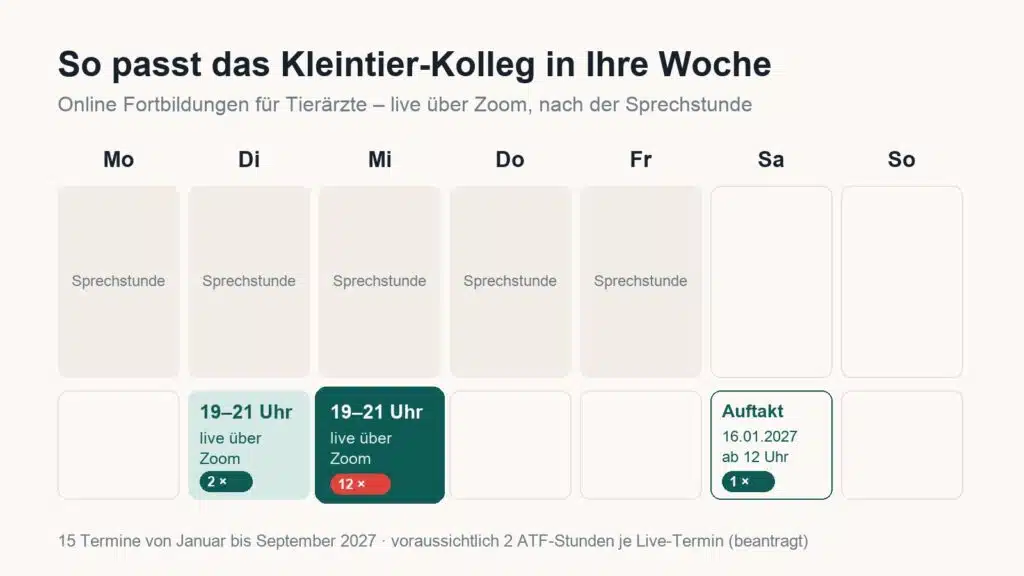
One point was paramount in the planning: the evenings should fit easily into a normal work week. Fourteen of the fifteen sessions begin at 7 p.m., twelve of them on a Wednesday and two on a Tuesday. Only the introductory session on oncology on Saturday, January 16, 2027, begins at noon and lasts approximately two to three hours. This demonstrates how online continuing education for veterinarians can work during the week without requiring them to take a day off work.
Topics and dates 2027
| Theme | Appointments | Speaker |
|---|---|---|
| Oncology in dogs and cats | Sat 16.01.2027, from 12 noon (approx. 2–3 hours) Tue 19.01.2027, 7–9 pm | Dr. Sandra Kühnel-Lawatsch |
| Respiratory system: BOAS and laryngeal paralysis | Wed 17.02.2027, 19–21 pm | Dr. Anna Trillig |
| Nose and ear: Rhinitis and otitis | Wed 17.03.2027, 19–21 pm | Dr. Anna Trillig |
| X-ray: thorax, abdomen, skeleton | Wed 14.04., 21.04. and 28.04.2027, 7–9 pm | Dr. Charlotte Günther |
| Soft tissue surgery | Tuesday, May 11, 2027 and Wednesday, May 12, 2027, 7–9 pm each day | Dr. Sandra Kühnel-Lawatsch |
| Orthopedics: Forelimbs and hindlimbs | Wed 09.06. and 23.06.2027, 19–20:45 each day | Dr. Nicola Hörtdörfer |
| Dentistry, in English | Wed 14.07. and 28.07.2027, 7–9 pm | Assistant Professor Dr. Ana Nemec |
| Ultrasound: Urogenital tract, gastrointestinal tract | Wed 01.09. and 15.09.2027, 7–9 pm | Dr. Charlotte Günther |
The evenings usually end around 9 p.m., except for the two orthopedic sessions, which end at 8:45 p.m. Those looking for online continuing education courses for veterinarians specifically focused on a particular area will find a dedicated page for each topic with all the dates. The three X-ray evenings in April, for example, are well-suited for systematically refreshing one's knowledge of the interpretation of thorax, abdomen, and skeleton.
The speakers
The seminar is being led by four veterinary specialists and an EBVS specialist in dentistry: Dr. Sandra Kühnel-Lawatsch (oncology, soft tissue surgery), Dr. Anna Trillig (respiratory system, nose and ear), Dr. Charlotte Günther (radiology, ultrasound), Dr. Nicola Hörtdörfer (orthopedics), and Assistant Professor Dr. Ana Nemec (dentistry). Dr. Nemec will present her topic in English.
You can find the profiles of the speakers here on the website of the Small Animal College. An overview of all course instructors at the Academy, including those for in-person courses, can be found at [link/website address]. Speakers.
Prices, ATF hours and technology
The costs of online continuing education courses for veterinarians vary considerably depending on the scope and format. At our college, for example, a single evening session costs €129.71 (€109 net). All 15 sessions are available for €1,535.10 (€1,290 net). Those who book by December 15, 2026, can take advantage of the early bird price of €1,416.10 (€1,190 net). All prices include VAT. The complete package is therefore significantly cheaper than booking 15 individual sessions.
Live participation is expected to award 2 ATF hours per session; accreditation has been applied for. Those unable to attend a session live can book a recording for €105.91 (€89 net) starting approximately three days after the event. The recording will be available for up to twelve months after the session, but will not award ATF hours and will not allow for Q&A sessions.
Technically, the requirements are low, as they should be for online continuing education courses for veterinarians. You need a computer, tablet, or smartphone with an up-to-date browser or the Zoom app. A camera and microphone are not required. You type your questions in the chat, and the presenter answers them live. Registration is done via [website/platform name]. own booking form, Payment is made by invoice.
Tips for planning your practical year
Online continuing education courses for veterinarians are most effective when they are part of a structured plan and not booked haphazardly. Three steps can help:
- Clarify obligations: Consult your chamber's professional regulations to find out how many hours are required, within what timeframe, and which formats count. Keep all your previous certificates of attendance in one place.
- Setting priorities: Which cases do you still refer today, and which findings leave you uncertain? This will determine the topics for the year.
- Block out appointments: Schedule live performances early in the work schedule to avoid any on-call shifts.
It's also worthwhile to consider the practice team. If two veterinarians from the same practice attend the same online continuing education courses, the knowledge gained can be more easily translated into shared procedures, such as a standardized X-ray protocol or coordinated consultations for brachycephalic patients. A brief case review the morning after the session keeps the knowledge fresh.
Regarding costs: Employees can generally claim work-related training costs as business expenses, while practice owners can deduct them as operating expenses. Whether and to what extent this applies in your case should be clarified with your tax advisor; this article does not replace tax advice. Employees should speak with the practice management to find out whether the practice covers the costs or whether the employment contract includes a training budget or training days.
One final tip: Consciously combine the formats. Online continuing education courses for veterinarians cover the theory throughout the year, while one or two in-person courses with Wetlab specifically deepen your practical skills. This creates a continuing education year that aligns with your chamber's requirements and noticeably advances your professional expertise.
Frequently asked questions about online continuing education for veterinarians
Do online continuing education courses for veterinarians count towards the continuing education requirement?
Yes, if they are recognized and your chamber accepts the format. The ATF (Academy for Veterinary Continuing Education) recognizes live online seminars without recording as well as interactive courses with learning progress assessments. According to the BTK (German Federal Chamber of Veterinary Surgeons) model professional code of conduct, there has been no upper limit for non-in-person continuing education courses since 2022. However, the professional code of conduct of your state or veterinary chamber is the determining factor.
Do I get ATF hours for a recording?
Only if the provider has had the recording recognized as their own interactive offering with a multiple-choice test. For the Small Animal College, ATF hours are awarded exclusively for live participation, presumably 2 per session (application submitted). Recordings do not award ATF hours.
How many hours of continuing education do I need to provide proof of?
Your chamber regulates this. The BTK model professional code stipulates 20 hours per year for practicing veterinarians, with more for those holding additional or specialist veterinary qualifications. Individual chambers deviate from this; Bavaria, for example, requires 60 hours of continuing professional development (CPD) over three years. The professional code of your chamber is binding.
Do I need a camera and microphone for online continuing education courses for veterinarians?
That depends on the provider. Not so with the Small Animal College: you follow the evening via Zoom and ask your questions in the chat. A computer, tablet, or smartphone with an up-to-date browser or the Zoom app is all you need.
When do the Small Animal College sessions take place?
Between January and September 2027. Fourteen of the fifteen sessions begin at 7 p.m., twelve of them on Wednesdays and two on Tuesdays. Only the opening session on Saturday, January 16, 2027, begins at noon and lasts approximately two to three hours.
Who can participate in the small animal college?
Only licensed veterinarians are present. You can book individual evenings or all 15 sessions, live or as a recording. Bookings are made via [website/platform name]. Booking form for the Small Animal College.
Are you looking for online continuing education courses for veterinarians that fit into your evenings and are led by specialists? Then take a look at the program of... Small Animal College 2027 15 sessions, eight subject areas, live via Zoom or as a recording. Secure your early bird price for all 15 sessions by December 15, 2026, and register directly via [link/website/etc.]. Booking form to.